
Thoughts,
Philosophy,
Questions.
Rethinking Mobile Food Service
The traditional mobile food industry offers flexibility, creativity and direct access to customers, but it also faces significant operational challenges. Limited space, labour dependence, unpredictable demand, complex ordering processes and short periods of intense customer traffic can place enormous pressure on both the kitchen and the service counter.
The central challenge is time control.
At festivals, markets, concerts and sporting events, customers often arrive in large numbers within a very limited timeframe. Traditional ordering conversations, payment processing, customised requests, food preparation and manual handover can create bottlenecks that affect everyone waiting.
Our self-serve food truck concept approaches this problem differently.
Rather than simply trying to make the traditional queue move faster, it removes several stages from the conventional ordering process. Customers can view what is available, make their choice, pay and collect directly, while the kitchen focuses on preparation, quality control and replenishment.
The following sections explore:
the realities and limitations of traditional mobile food service;
the effect of concentrated demand on food-truck operations;
why time is one of the most valuable commodities at busy events;
how ordering, customisation and payment can slow the entire service system;
the opportunities created by automation and parallel transactions;
a different interpretation of customer service and the principle that “the customer is king”;
the role of people within an automated food-service model;
the importance of kitchen capacity, food safety and product quality;
the limitations of the concept and the situations for which it may not be suitable; and
the questions, criticism and concerns that customers, event organisers and traditional operators may reasonably raise.
This is not an argument that every food truck should become automated.
It is an exploration of a specific problem and a different possible solution.
The problem is concentrated demand.
The limited resource is time.
The objective is not to remove hospitality, but to redefine service around speed, clarity, consistency and respect for the customer’s time.
80/20 Rule
✳︎
Time
✳︎
High Speed Service
✳︎
Rethink
✳︎
More Income-Less Costs
✳︎
80/20 Rule ✳︎ Time ✳︎ High Speed Service ✳︎ Rethink ✳︎ More Income-Less Costs ✳︎
Rethinking Mobile Food Service
The challenges. The opportunities. A different approach to time.
The traditional mobile food industry has transformed the way people experience food.
Food trucks bring creativity, variety and independent hospitality directly to festivals, sporting events, markets, workplaces and local communities. They can operate where permanent restaurants cannot, introduce customers to new cuisines and create an atmosphere that is difficult to reproduce inside a conventional venue.
But the traditional food-truck model also has limitations.
A food truck may be mobile, but the service system it uses is often nearly identical to the system used by a traditional takeaway restaurant:
Join the queue. Read the menu. Place an order. Discuss the options. Pay. Wait. Listen for your name or number. Collect the food.
This process can work perfectly well when customers arrive gradually.
It becomes far more difficult when hundreds or thousands of people want food at approximately the same time.
At a concert, sporting event or busy festival, the greatest operational challenge is not always food.
It is time.
TIME CONTROL
Time control is not simply about cooking faster.
It means controlling the complete period between the moment a customer decides to buy food and the moment that customer receives it.
That includes:
deciding what to order;
joining the queue;
discussing the menu;
requesting changes;
processing payment;
communicating the order to the kitchen;
preparing or assembling the product;
identifying the completed order; and
handing it to the correct customer.
Every one of these stages consumes time.
When demand is low, that time may not matter.
When demand suddenly increases, every unnecessary second becomes part of the queue.
Our self-serve food truck concept starts with that problem.
Not with the machine.
Not with automation for the sake of automation.
With time.
The Reality of Traditional Mobile Food Service
Traditional food trucks often combine several different businesses inside one limited vehicle.
They are:
a kitchen;
a storage facility;
a refrigeration area;
an order counter;
a payment point;
a collection point;
and a customer-service desk.
All of those functions compete for a very small amount of space.
The operator must manage food preparation, customer communication, cooking, packaging, payment, cleaning, safety, stock control and handover - often while working only centimetres away from other team members.
The result can be an impressive display of teamwork.
It can also create bottlenecks.
One customer, one conversation, one transaction
In the conventional model, each customer generally passes through the same order-taking point.
The employee asks what the customer wants.
The customer may ask questions.
The order may be changed.
A side may be substituted.
A sauce may be removed.
A second person may change their mind.
A group may want to pay separately.
A card may decline.
The order must then be communicated to the kitchen, prepared correctly and matched to the right customer.
None of these situations is unusual.
None of them necessarily makes the customer unreasonable.
But together they consume time.
One complicated transaction does not delay only one customer.
It delays everyone waiting behind that customer.
The Queue Is More Complicated Than It Looks
A customer may believe they are standing in one queue.
In reality, a traditional food-truck transaction can involve several different queues:
a queue to read the menu;
a queue to place an order;
a queue to ask questions;
a queue to pay;
a queue inside the kitchen;
a queue for assembly;
and a queue for collection.
A delay at any one of those stages can reduce the performance of the entire operation.
Adding another cook does not necessarily solve a slow ordering process.
Adding another cashier does not solve insufficient cooking capacity.
Expanding the menu does not help if greater choice makes customers slower to decide and makes production more difficult.
The effective capacity of the truck is determined by its slowest essential stage.
That stage becomes the bottleneck.
High Foot Traffic Changes Everything
The mobile food industry is often judged by total event attendance.
But total attendance does not reveal when customers will want food.
An event may attract thousands of visitors over several hours, yet the majority of food demand may arrive in a few short waves.
This happens during:
sporting intervals;
concert breaks;
school lunch periods;
shift changes;
university class breaks;
market peaks;
and scheduled programme pauses.
During a sporting event or music festival, thousands of people may leave their seats or viewing areas at the same moment.
They may have only 15 or 20 minutes available.
That creates a very different problem from normal restaurant service.
The food business does not have the luxury of spreading the demand across the day.
The opportunity exists for a short period.
Then it disappears.
A customer who sees a long queue may:
choose another vendor;
decide not to buy;
purchase less than intended;
return to the event hungry;
or miss part of the programme while waiting.
A long queue can therefore be misleading.
It may look like success.
It may actually represent lost sales.
The visible queue contains only the people who decided to wait.
It does not show the people who walked away.
The Hidden Cost of the Ordering Conversation
Hospitality is often associated with conversation.
That can be valuable.
Customers may want recommendations, explanations or reassurance. Some enjoy personal contact with the people preparing their food.
But not every conversation at an order counter is meaningful hospitality.
Much of it is purely functional:
“What would you like?”
“Which sauce?”
“Did you want one or two?”
“Can you remove this?”
“Can we swap that?”
“Was that a meal?”
“Can we pay separately?”
“Do you have anything without this ingredient?”
All of these questions can be legitimate.
The problem is not the question itself.
The problem is that every customer behind that conversation is forced to wait for it to finish.
A relatively small number of complex transactions can consume a disproportionate amount of service time.
This is where the Pareto Principle, often described as the 80/20 rule, becomes useful.
It should not be treated as a literal statement that exactly 20 per cent of customers create exactly 80 per cent of delays.
It describes a familiar operational pattern:
A small proportion of complex orders can create a large proportion of the waiting time.
The challenge is not the individual customer.
The challenge is a system that allows one complicated transaction to interrupt every simple transaction behind it.
The Customer Is King
The phrase “the customer is king” is deeply embedded in hospitality.
But what does it really mean?
Does it mean every business must offer every possible change, substitution and variation?
Does it mean an entire queue must wait while one individual order is redesigned?
Does it mean a food business cannot define its own operating model?
No business serves every customer in every possible way.
A fine-dining restaurant offers a different experience from a drive-through.
A banquet offers a different experience from an à la carte restaurant.
An all-you-can-eat-buffet offers a different experience from a personal chef.
Each model makes a different promise.
The customer remains king because the customer can choose the service that best suits the occasion.
Our interpretation is simple:
The customer is king when the business clearly understands what the customer needs and reliably delivers it.
In a high-foot-traffic environment, many customers do not primarily want a long ordering conversation.
They want:
a clear choice;
a clear price;
hot food;
fast payment;
immediate collection;
and enough time to return to the event.
Respecting the customer can mean respecting the customer’s time.
It Is Not for Everyone
Our self-serve food truck is not intended to replace every traditional food truck, restaurant or made-to-order kitchen.
It is not designed for every customer.
And it does not need to be.
Customers who want extensive personalisation, a detailed conversation about every ingredient, or a meal individually redesigned at the point of sale may prefer a traditional made-to-order business.
That is a valid choice.
Our concept is designed for customers who value:
speed;
certainty;
visible availability;
convenience;
consistent presentation;
transparent pricing;
independence;
and control over their own transaction.
This is not a weakness.
It is clear market positioning.
A strong business does not have to serve everyone.
It must understand precisely who it serves and what problem it solves.
The Problem Is Not the Queue Alone
A common response to long queues is to make the traditional line move faster.
Businesses may add:
another cashier;
another order screen;
a mobile ordering app;
more staff;
runners;
collection numbers;
a second payment terminal;
or a larger menu board.
These measures can help.
But they often leave the original process intact:
Order first. Prepare second. Collect later.
Our thinking begins with a different question:
Why must every customer place an individual order before the product becomes available?
Instead of speeding up every stage of the traditional system, we remove several of those stages.
The customer:
sees what is available;
chooses the product;
pays;
opens the compartment;
and takes the food.
There is no separate verbal order.
There is no order ticket.
There is no customer name.
There is no collection number.
There is no search for the correct bag.
There is no separate handover.
The payment, access and collection become one process.
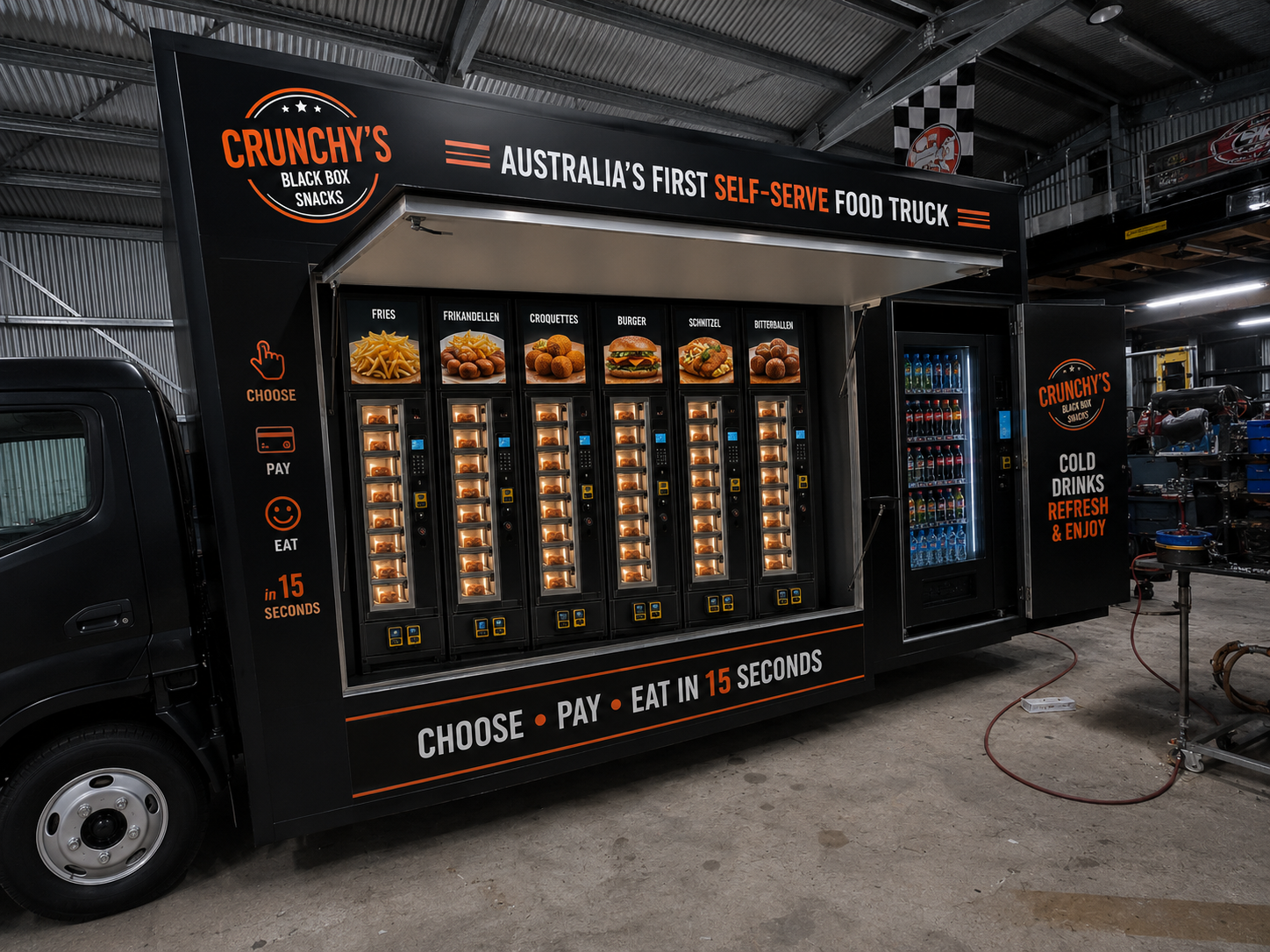
CHOOSE • PAY • EAT IN 15 SECONDS
A Different Way of Thinking
The self-serve food truck does not merely add machines to a traditional truck.
It changes the operating logic of the business.
From reactive production to predictive production
A traditional kitchen generally reacts to orders.
The customer orders first.
The kitchen then prepares or assembles the product.
During a rush, this can create uneven production:
many orders arrive simultaneously;
products have different cooking times;
variations interrupt standard preparation;
staff move between cooking, packaging and order checking;
and customers wait while their individual order advances through the system.
The self-serve model is more predictive.
The kitchen focuses on:
what is selling;
which compartments are empty;
what customers are likely to choose next;
when the next demand wave will arrive;
and which products need to be replenished first.
The question changes from:
What has just been ordered?
to:
What will our customers need next?
The kitchen still cooks.
The staff still monitor quality.
But production is organised around controlled availability instead of a constant stream of individual instructions.
Customisation Through Better Menu Design
One criticism of self-service is that customers cannot modify every product.
That is partly correct.
A product that is already cooked and ready for collection cannot be changed as freely as an order that has not yet been prepared.
But customisation does not have to disappear completely.
It can be anticipated.
Popular variations may be offered as separate products, such as:
plain;
with sauce;
without sauce;
different sauce combinations;
a smaller portion;
a larger portion;
a meal combination;
or a different product version.
The important difference is that customisation is planned before the rush.
It is not negotiated during the busiest moment.
This approach also encourages menu discipline.
Not every imaginable variation needs to be offered.
The menu should reflect what customers genuinely buy and what the kitchen can reliably produce.
More choice is not always better service.
Too much choice can:
slow decisions;
increase stock;
complicate preparation;
create more questions;
increase waste;
and reduce consistency.
The objective is not the largest menu.
It is the right menu.
Parallel Service
The most important advantage of our model is not merely that one transaction can be completed quickly.
It is that multiple customers can use multiple machines at the same time.
Traditional service is often sequential.
One customer speaks to the employee.
The next customer waits.
With multiple independent machines, several transactions can take place in parallel.
One customer may take longer to choose at one machine without necessarily stopping another customer from purchasing at another machine.
The system changes from one narrow gateway into several independent service points.
That is where significant time control becomes possible.
The Mathematics of Time
At one completed transaction every 15 seconds, one continuously operating transaction point has a theoretical capacity of:
four transactions per minute;
60 transactions in 15 minutes;
or 80 transactions in 20 minutes.
These figures explain the potential of the transaction system.
They are not a guarantee of actual sales.
Real-world throughput depends on:
how quickly customers decide;
payment-processing speed;
product availability;
the number of items purchased;
compartment access;
customer familiarity;
machine performance;
kitchen output;
and replenishment speed.
Three different capacities must therefore be considered.
Transaction capacity
How quickly can the customer select, pay and collect?
Product availability
How many suitable products are ready for sale?
Kitchen capacity
How quickly can sold products be replaced?
The machines may remove the order-counter bottleneck.
They do not create unlimited cooking capacity.
If the machines are emptied faster than the kitchen can replenish them, the bottleneck moves from the counter to production.
That does not invalidate the concept.
It demonstrates why the truck must be designed as one complete operating system.
The front end and the kitchen must support each other.
Time Control Is More Than Speed
Speed alone is not enough.
A kitchen can look busy without being efficient.
Employees can work faster without reducing the customer’s total waiting time.
A quick payment is meaningless if the customer must then wait 20 minutes for the order.
Time control means understanding and managing the entire process.
It includes:
anticipating peak periods;
preparing high-demand products before the rush;
limiting unnecessary complexity;
monitoring compartment availability;
measuring replenishment;
controlling holding times;
directing staff towards the most urgent production tasks;
and using actual sales information to improve future decisions.
The goal is not to make people work harder.
The goal is to design a system in which less time is wasted.
The Challenges Facing Traditional Food Trucks
Limited space
A food truck has strict physical limits.
Every additional menu item may require:
more ingredients;
more storage;
separate utensils;
additional refrigeration;
different preparation methods;
more packaging;
and additional cleaning.
A menu that looks impressive on paper may be difficult to produce reliably inside a compact vehicle.
Labour dependence
Traditional food service can require people to:
explain the menu;
take orders;
process payments;
communicate with the kitchen;
assemble meals;
check orders;
call names or numbers;
hand over products;
and correct mistakes.
Our model does not eliminate the need for people.
It changes where their time is used.
Staff can focus more heavily on:
food preparation;
replenishment;
quality control;
cleaning;
food safety;
stock management;
and customer assistance.
The discussion is not people versus machines.
It is about using people where human skill and judgement add the most value.
Unpredictable demand
Food-truck operators often depend on event information that may not accurately predict actual trade.
Attendance figures do not reveal:
how many people will buy food;
when they will buy;
how many vendors will be present;
whether menus overlap;
what visitors are willing to spend;
or whether weather will change customer behaviour.
Automation does not make a poor event profitable.
It does, however, improve the ability to process genuine demand when that demand appears.
Rising costs
Mobile food operators face increasing pressure from:
ingredients;
labour;
packaging;
fuel;
electricity;
insurance;
licences;
maintenance;
event fees;
payment charges;
and waste.
The traditional response is often to increase prices.
But customers are also sensitive to higher costs.
Another response is to increase productivity:
reduce repetitive labour;
decrease order errors;
reduce lost sales;
improve stock visibility;
increase completed transactions;
and improve production planning.
Technology is only valuable when it produces better practical outcomes.
Automation by itself is not a business strategy.
The Opportunities
Capturing lost sales
A long queue may represent strong demand.
It may also represent customers the business is failing to serve quickly enough.
The customers who remain in the queue are only part of the picture.
The business cannot easily count those who:
looked at the queue and walked away;
decided not to buy;
purchased from another vendor;
or returned to the event without food.
Reducing friction creates an opportunity to convert more interest into actual sales.
Making better use of short demand windows
At many events, the most valuable trading period may last only 15 or 20 minutes.
Increasing capacity during that short period can be more valuable than remaining open for an additional quiet hour.
This makes the concept particularly relevant for:
music festivals;
sporting events;
schools;
universities;
hospitals;
factories;
transport locations;
workplaces;
and other environments where many people become available at the same time.
Greater customer independence
Customers should not need to:
download an app;
create an account;
enter a name;
navigate multiple screens;
remember an order number;
or wait for their order to be called.
The process should be immediate and intuitive:
See it. Choose it. Pay for it. Take it.
Technology should make purchasing easier.
It should not transfer unnecessary administration from the employee to the customer.
Better operating information
A connected self-serve system can provide valuable information about:
product sales;
peak periods;
machine use;
transaction timing;
sell-out patterns;
product popularity;
and replenishment requirements.
That information can support better decisions about:
future menus;
production volumes;
staffing;
purchasing;
event selection;
and waste reduction.
The truck becomes more than a mobile kitchen.
It becomes a measurable operating system.
Shifting the Value of Human Interaction
A self-serve model is sometimes criticised for reducing human contact.
But human interaction is not removed.
It is repositioned.
Staff remain responsible for:
preparing the food;
monitoring quality;
maintaining safe temperatures;
replenishing the machines;
cleaning the equipment;
welcoming customers;
assisting first-time users;
answering important questions;
and resolving problems.
The machine handles the repetitive transaction.
People remain responsible for the food and the hospitality.
We are not removing people from customer service.
We are removing the requirement that every customer must have the same transactional conversation before receiving food.
Human interaction remains available when it is useful.
It is no longer a compulsory bottleneck.
Efficiency as a Service
Efficiency is sometimes portrayed as cold or impersonal.
But delay is not automatically more human.
There is nothing particularly hospitable about making a parent wait in a long queue with hungry children.
There is nothing customer-focused about causing someone to miss part of the event they paid to attend.
There is nothing personal about forcing dozens of people to wait because one transaction has become complicated.
In a time-sensitive environment, efficiency can be one of the highest forms of service.
Efficiency means understanding that the customer’s time has value.
At a concert, market or sporting event, the customer’s main desire may not be a long conversation with the chef.
It may simply be to receive hot food quickly and return to the occasion.
In those circumstances:
EFFICIENCY IS THE SERVICE
Consistency
A traditional rush creates pressure.
Employees become tired.
Noise makes communication difficult.
Orders can be misunderstood.
Payments can be delayed.
Similar bags can be confused.
Names and numbers can be missed.
A machine cannot remove every possible problem.
But it can remove some common points of error.
The customer sees the available product.
The customer selects that product.
The customer pays for that product.
The customer collects that product.
There is no separate interpretation between the spoken order and the final handover.
Consistency is not less personal service.
Consistency is reliable service.
Frequently Asked Questions and Criticism
We can imagine you have questions left. We collected the questions already asked and maybe the answer to yours are HERE.
What We Do Not Claim
Credibility requires honesty.
Our concept does not claim that:
machines never fail;
every customer prefers self-service;
all food can be prepared in advance;
every queue will disappear;
customisation has no value;
staff are no longer required;
every event will be profitable;
technology automatically creates good hospitality;
or the model is suitable for every cuisine.
We make a more focused claim:
In high-foot-traffic environments, traditional ordering, payment and handover systems can become significant bottlenecks.
A carefully designed self-serve system can reduce those bottlenecks, allow parallel transactions and give the operator greater control over time.
A Different Definition of Customer Service
Traditional customer service is often measured by the attention given to each order.
Our model asks a wider set of questions:
Was the choice clear?
Was the price clear?
Was the food visible?
Was the product available?
Was payment simple?
Was assistance available?
Was the food hot and consistent?
Did the customer receive what was selected?
How much of the customer’s time was consumed?
Did the customer miss part of the event?
A long conversation may be valuable in some environments.
In others, the most considerate service is the service that allows the customer to leave quickly.
We Began With the Problem
The self-serve food truck is not an attack on the traditional mobile food industry.
Traditional food trucks will continue to offer outstanding food, creativity, personal service and memorable experiences.
Our concept addresses one particular weakness of the traditional model:
The difficulty of serving concentrated demand within a short and inflexible period.
We did not begin with vending technology and search for a reason to use it.
We began with the problem.
The problem was time.
The technology offered a different solution.
The food is still cooked by people.
The kitchen remains essential.
Quality remains essential.
Food safety remains essential.
Customer service remains essential.
But the sequence changes.
Instead of requiring every customer to explain, order, pay, wait and collect, the products are made visible and available.
The customer chooses.
The customer pays.
The customer collects.
The kitchen focuses on cooking, quality and replenishment.
This is not less hospitality.
It is hospitality reorganised around the needs of a high-foot-traffic environment.
It is not for every customer.
It is not for every food business.
It is not for every occasion.
But where demand is high and time is scarce, it offers a different answer to an old problem.
TIME CONTROL
CHOOSE • PAY • EAT IN 15 SECONDS
Because at a festival, concert, market or sporting event, people should spend their time enjoying the occasion—not waiting to place an order.
This version can serve as a principal website page, with the FAQ section also reusable as individual accordion items.
Our Position
Our self-serve food truck concept is not for everyone, and it does not need to be.
It is designed for the customer who looks at a long queue and decides not to join it.
It is designed for the parent trying to feed a family before the next performance begins.
It is designed for the sports supporter who does not want to miss the start of the second half.
It is designed for the event organiser who needs a food provider capable of managing sudden peaks in demand.
Traditional food service asks customers to wait while the business processes each order.
Our system turns that model around.
The food is prepared. The choices are visible. The price is clear. The customer remains in control.
Choose • Pay • Eat in 15 seconds.
Frequently Asked Questions and Criticism
We can imagine you have questions left. We collected the questions already asked and maybe the answer to yours are HERE. Please, feel free to DROP US A LINE if the answer to your question is not here.
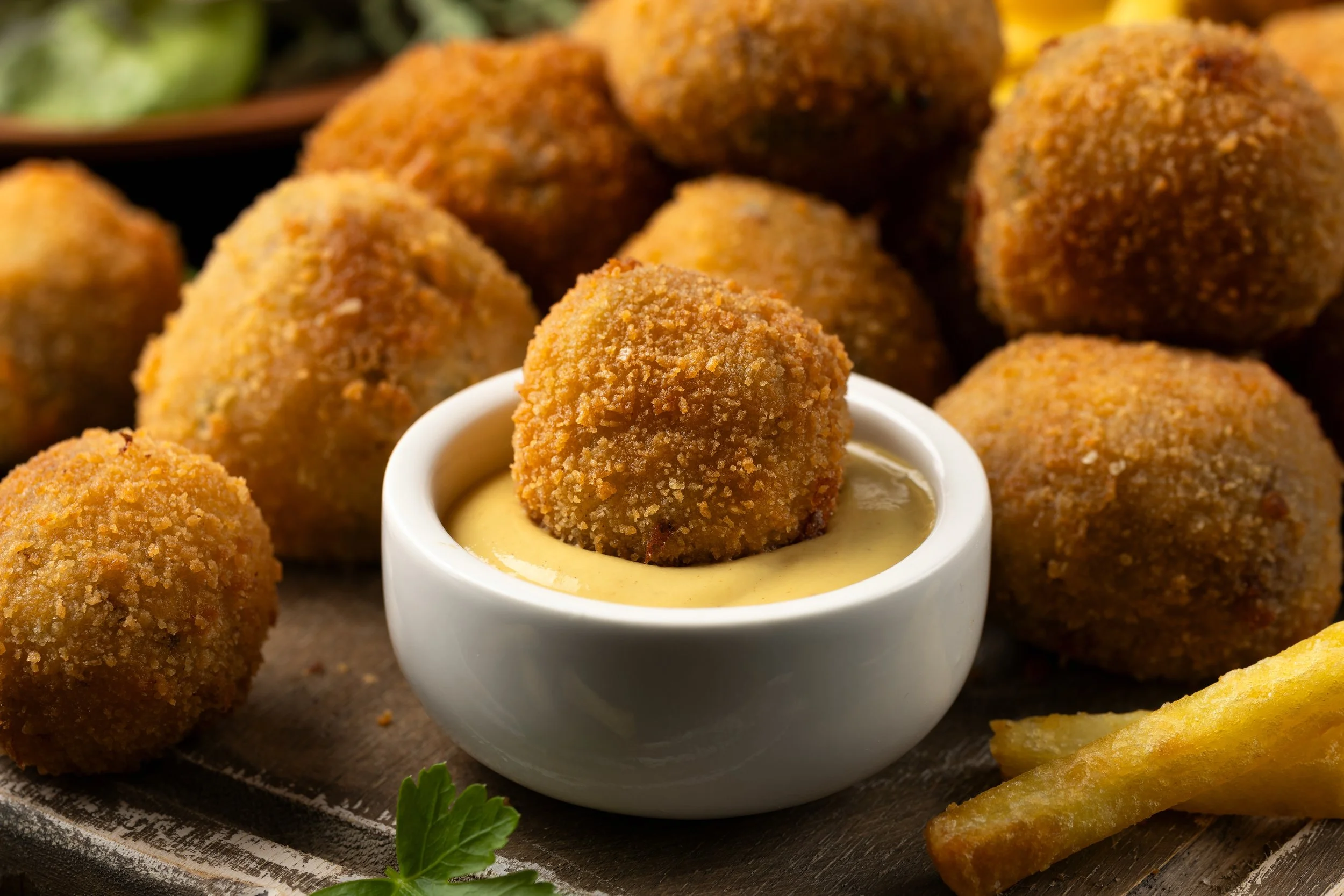
Bitterballen
Get In Touch
If you're interested in working with us, complete the form with a few details about your project. We'll review your message and get back to you within 48 hours.